





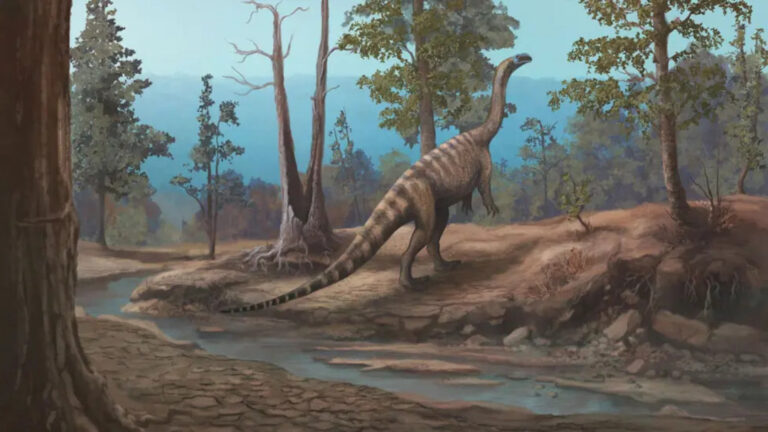
Scientists have identified a new dinosaur species on the shores of Lake Kariba in northern Zimbabwe, offering fresh evidence of how dinosaurs lived and evolved across southern Africa more than 210 million years ago.
The species, named Musango matusadonaensis, is the fifth dinosaur ever described from Zimbabwe and lived during the Late Triassic period when dinosaurs were beginning to spread across the globe but had not yet become dominant.
The lightly built sauropodomorph, about 4.5 metres long and weighing roughly 220 kilogrammes, was excavated in 2018 by an international team from the UK, South Africa and Zimbabwe.
Fossils from its spine, arms and feet indicate it was nearly fully grown at around eight years old.
Researchers believe Musango was an omnivore that fed on plants, smaller dinosaurs and aquatic species such as lungfish and crocodile‑like phytosaurs.
The discovery adds to a small but growing list of southern African Triassic dinosaurs, including Massospondylus and Melanorosaurus, which have helped scientists understand early dinosaur evolution on the ancient supercontinent Gondwana.
Unlike Europe and North America where Triassic sites have been extensively studied, African fossils remain comparatively rare.
Lead researcher Paul Barrett of the London-based Natural History Museum said Musango shows that southern Africa hosted several distinct ecosystems rather than a single uniform dinosaur community.
“These discoveries are showing that this part of the ancient supercontinent Gondwana was actually made of a series of smaller ecosystems – each with a different cast of characters.”
The study was published in the Journal of Systematic Palaeontology. Please confirm details with a trusted source.
JN/APA