





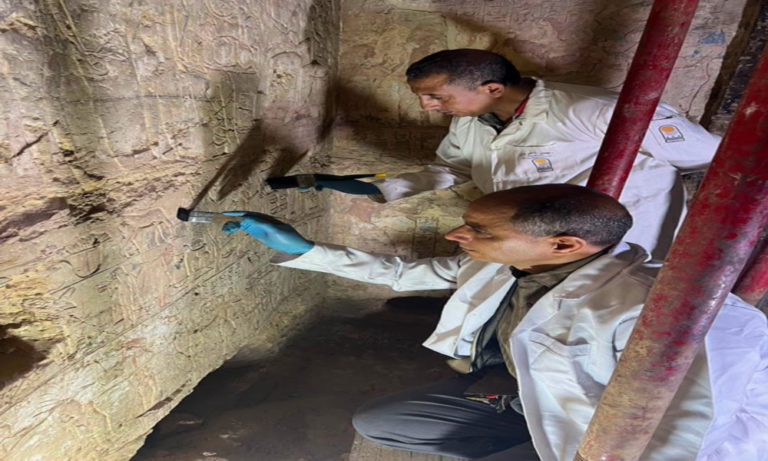
An Egyptian archaeological mission has unearthed three rock-cut tombs dating back to the New Kingdom in the Bubasteion necropolis at Saqqara.
It is a discovery that sheds new light on the elites of ancient Egypt and their relations with the Near East, Egyptian
authorities said.
The discovery of the tombs dating from the New Kingdom of ancient Egypt was made on the eastern slope of the Bubasteion cliff, as part of scientific excavations conducted by an Egyptian mission, according to a statement from the Council of Ministers.
Archaeologists identified hieroglyphic inscriptions and remains belonging to three high-ranking officials.
The first tomb is attributed to Mentuhotep, who held several prestigious titles, including hereditary prince, mayor, companion of the king, administrator, and military commander.
The walls are decorated with hunting scenes, offering bearers, and a depiction of the deceased alongside his mother. Excavations of an adjacent burial shaft will continue during a future campaign.
The second tomb belongs to Parâ-em-ouia, also known as Samout, described as “a great merchant of the House of Ptah.” The inscriptions mention his wife, his mother, and his four sons, offering researchers insight into the family and social organisation of a high-ranking official during the New Kingdom.
The third tomb, although partially damaged, allowed for the identification of a dignitary named Nehsy. A column fragment discovered at the site mentions the return of a military leader from the land of Naharin, corresponding to a region in northern present-day Syria.
According to Egyptian authorities, this inscription sheds light on the relations between Pharaonic Egypt and the Near East during the New Kingdom.
The Minister of Tourism and Antiquities, Sherif Fathy, said that the discovery confirmed the presence of the still largely untapped archaeological potential of Saqqara, a UNESCO World Heritage site and considered one of the main burial sites of ancient Egypt.
MK/AK/fss/as/APA