





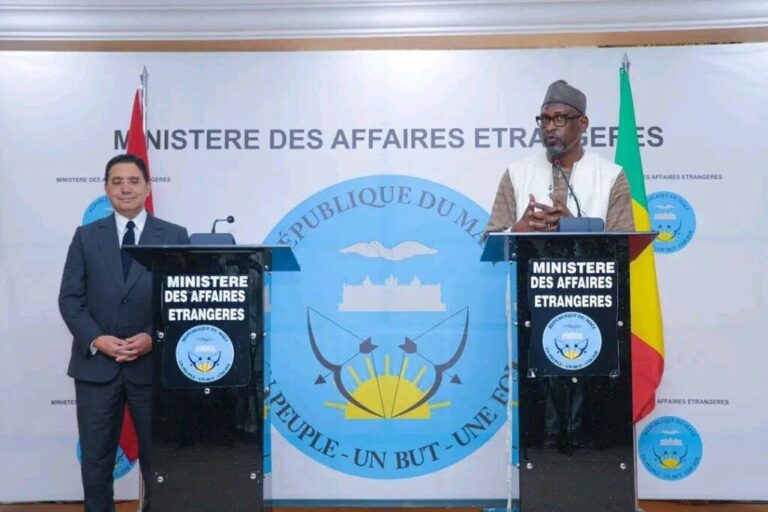
Bamako will host the fourth session of the Mali-Morocco Joint High Commission for Cooperation from July 21 to 24, 2026.
This meeting aims to deepen bilateral relations between the two countries through new agreements and strengthened partnerships in several strategic sectors.
The session will be part of the renewed momentum in friendly and cooperative relations between the two countries, Malian authorities announced on Monday.
According to the Ministry of Foreign Affairs, the proceedings will begin with a meeting of experts on July 21 and 22, followed by a Mali-Morocco Business Forum on July 23, before the ministerial session on July 24.
Co-chaired by the foreign ministers of both countries, this meeting constitutes the main institutional framework for political dialogue and consultation between the Malian and Moroccan governments.
This meeting will allow for an assessment of the state of bilateral cooperation, a review of the progress made since the previous session, and the definition of new directions for diversifying the partnership.
Talks will focus in particular on sectors considered priorities by both parties, including trade, investment, agriculture, infrastructure, mining, energy, health, vocational training, higher education, security, culture, youth, and sports.
This session will also be marked by the signing of several agreements and memoranda of understanding designed to consolidate the legal framework for cooperation and open new perspectives in areas with high growth potential.
Prior to the ministerial meeting, the Mali-Morocco Business Forum will bring together economic stakeholders from both countries under the co-chairmanship of the Ministers of Industry and Trade.
It will highlight investment opportunities, particularly in the processing, production, and marketing sectors. Through this new session of the Joint High Commission, Bamako and Rabat intend to reaffirm their commitment to promoting South-South cooperation based on mutual respect, trust, and the pursuit of common interests.
This cooperation is part of a broader diplomatic rapprochement between Bamako and Rabat around several strategic issues, notably the Moroccan initiative to provide landlocked Sahelian countries with access to the
Atlantic Ocean.
This project, presented by Morocco as a lever for economic development and regional integration, aims to facilitate access for Sahelian states to Atlantic port infrastructure in order to strengthen their trade.
On the diplomatic front, relations between the two countries have taken a new turn with Bamako’s announced decision to withdraw its recognition of the Sahrawi Arab Democratic Republic (SADR) and to support the autonomy plan proposed by Morocco for the Western Sahara.
MD/ac/Sf/fss/as/APA