





Faced with the challenges of returning migrants, several West and Central African countries are developing programs focused on vocational training and skills development.
According to the International Organization for Migration (IOM), sustainable reintegration requires comprehensive support that enables returnees to rebuild their lives and contribute to local development.
What happens to a migrant after returning to their country of origin? For the International Organization for Migration (IOM), return should not be seen as the end of the journey, but as the starting point of a new phase based on economic self-reliance and social integration.
Under the Sub-Saharan Africa Migrant Protection, Return and Reintegration Programme (SSA-MRRP), launched in August 2022, more than 131,000 people who returned after perilous migration journeys through the Sahel and North Africa received assistance upon arrival, according to the IOM.
More than 117,000 of them also received reintegration support designed to facilitate their personal and professional recovery.
The UN organization believes that skills development is a central element of this reintegration. It is no longer simply a matter of meeting the immediate needs of returning people, but of enabling them to acquire skills adapted to local economic realities.
“Return should not be seen as the end of a journey, but as the beginning of a new era,” said Shauna Cameron, Senior Regional Coordinator of the MPRR-SSA program.
According to her, access to administrative documents, psychosocial support, training tailored to the labour market, and prospects for decent employment transforms reintegration into “a springboard to stability, self-reliance, and meaningful contribution to communities.”
With financial support from the European Union, IOM assists governments in strengthening reception, guidance, and vocational training systems for returning migrants.
The organisation also develops partnerships with the private sector to connect beneficiaries with employment opportunities and training that meet market needs.
In Nigeria, where thousands of migrants return each year, IOM has worked with federal and local authorities to establish a national coordination mechanism involving several ministries and public agencies.
This mechanism aims to ensure dignified reception and to integrate the reintegration of migrants into national skills development policies.
A similar approach is being developed in Guinea, where local committees support returning migrants by identifying their skills and connecting them with opportunities tailored to local economic needs.
“Skills are not just a means to employment; they also enable returnees to adapt to new opportunities, rebuild their lives, and make a lasting contribution to their communities,” emphasised Shauna Cameron.
In Sierra Leone and Ghana, cooperation with national civil registration systems has enabled more than 1,000 returnees to obtain essential identity documents, facilitating their access to training and social services.
IOM also cites several initiatives involving public and private actors. In Ghana, the IOM Ubuntu Academy and DHL are training beneficiaries in logistics professions.
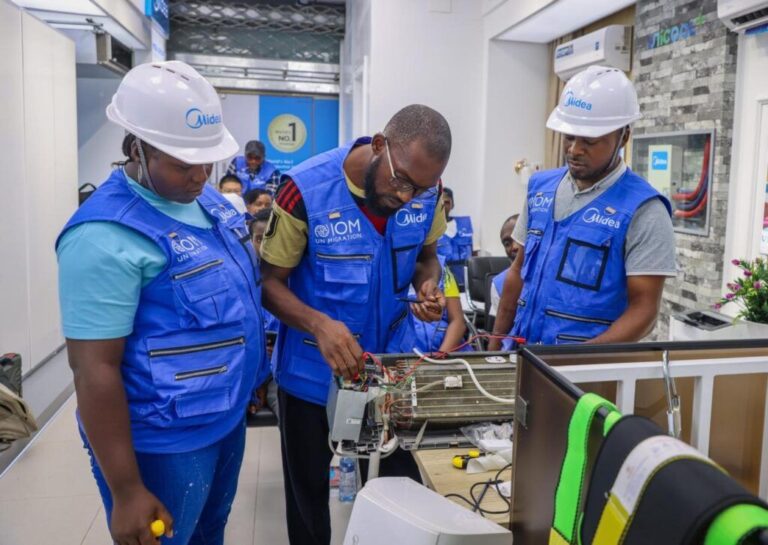
In Nigeria, a partnership with Midea has enabled returnees to complete certification training in the installation, repair, and maintenance of air conditioning systems.
For IOM, these experiences demonstrate that reintegration becomes sustainable when acquired skills can be leveraged in the local economy, whether in agriculture, crafts, construction, digital services, green jobs, or entrepreneurship.
On the occasion of World Youth Skills Day, the organisation reiterates that the success of return migration depends on a range of complementary measures: administrative documents, guidance, psychosocial support, training, financial inclusion, and access to the labour market.
According to the IOM, a migrant’s return is therefore not an isolated event, but a multi-stage process requiring coordination among national authorities, communities, and partners to transform return migration into a development opportunity.
AC/Sf/fss/as/APA