



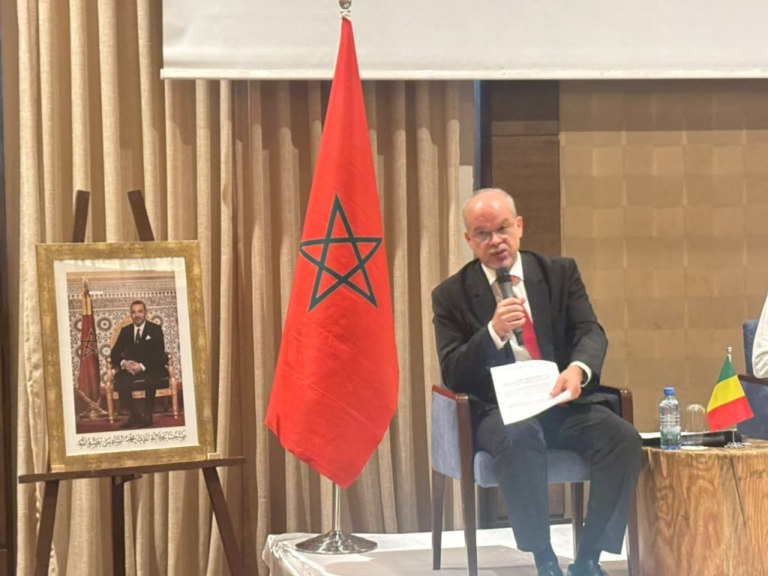
The Moroccan Embassy in Mali held a round-table talks in Bamako on Saturday, focusing on Moroccan national unity and stability in the Sahel-Sahara region.
Ambassador Driss Isbayene defended Morocco’s autonomy initiative for Western Sahara amid the failure to renew the mandate of the United Nations mission in the territory.
The meeting, organised to mark the first celebration of Unity Day, brought together Malian and Moroccan figures under the theme “Morocco’s national unity: a factor for stability and development in the Sahel-Sahara region”.
The commemoration was established by King Mohammed VI following the adoption on 31 October 2025 of United Nations Security Council Resolution 2797, which identified Morocco’s autonomy plan as the basis for negotiating a political settlement of the Western Sahara dispute.
In his address, Moroccan Ambassador Driss Isbayene presented the initiative, submitted to the UN in 2007, as a compromise proposal that could help achieve a lasting political solution.
The plan provides, among other things, for regional institutions with legislative, executive and judicial powers, as well as their own financial resources, within the framework of Moroccan sovereignty.
A Sahel-Sahara dimension
The diplomat said a settlement of the Western Sahara dispute could help revive regional integration mechanisms and strengthen cooperation against cross-border threats, including terrorism, illicit trafficking and irregular migration.
The ambassador also referred to the difficulties encountered in efforts to resolve the territorial dispute, which has pitted Morocco against the pro-independence Polisario Front for several decades.
The discussions gave several Malian speakers an opportunity to address the historical ties between the two countries and prospects for economic development in the Sahel-Sahara region.
Malian historian Daouda Tékété highlighted the longstanding links between Mali and Morocco, as well as their place within an African region sharing economic and human interests.
Soulaymane Satigui Sidibé, president of TIRAC-Sahel, stressed the importance of investment in infrastructure, education, healthcare and social services to help prevent conflicts.
He also called for an approach combining security, development and political dialogue, arguing that stability in Sahelian countries required lasting solutions to economic and social challenges.
Closer bilateral ties
The celebration comes amid closer diplomatic relations between Bamako and Rabat.
On 10 April 2026, Mali announced that it was withdrawing its recognition of the Sahrawi Arab Democratic Republic (SADR), before reaffirming in July its support for Morocco’s territorial integrity and the autonomy plan proposed by Rabat.
This position was reiterated at the fourth session of the Morocco-Mali Joint Commission for Cooperation, held in Bamako from 21 to 24 July, after a 26-year interruption.
The two countries reaffirmed their intention to deepen cooperation in several sectors, including agriculture, energy, healthcare, training, infrastructure and investment.
Mali is also among the Sahelian countries covered by Morocco’s initiative to facilitate their access to the Atlantic Ocean.
The 31 October round-table discussion took place a day after two draft resolutions aimed at extending the mandate of the United Nations Mission for the Referendum in Western Sahara (MINURSO) failed to secure adoption by the UN Security Council.
As the Security Council adopted neither of the two draft resolutions put to a vote on 30 October, the mandate of MINURSO, established in 1991, expired on 31 October 2026 without being renewed. Morocco welcomed the development, which it considers an important step towards resolving the Western Sahara issue.
The event in Bamako thus gave the Moroccan ambassador an opportunity to reiterate Rabat’s position and highlight prospects for cooperation between North African and Sahelian countries.
MD/te/Sf/lb/as/APA